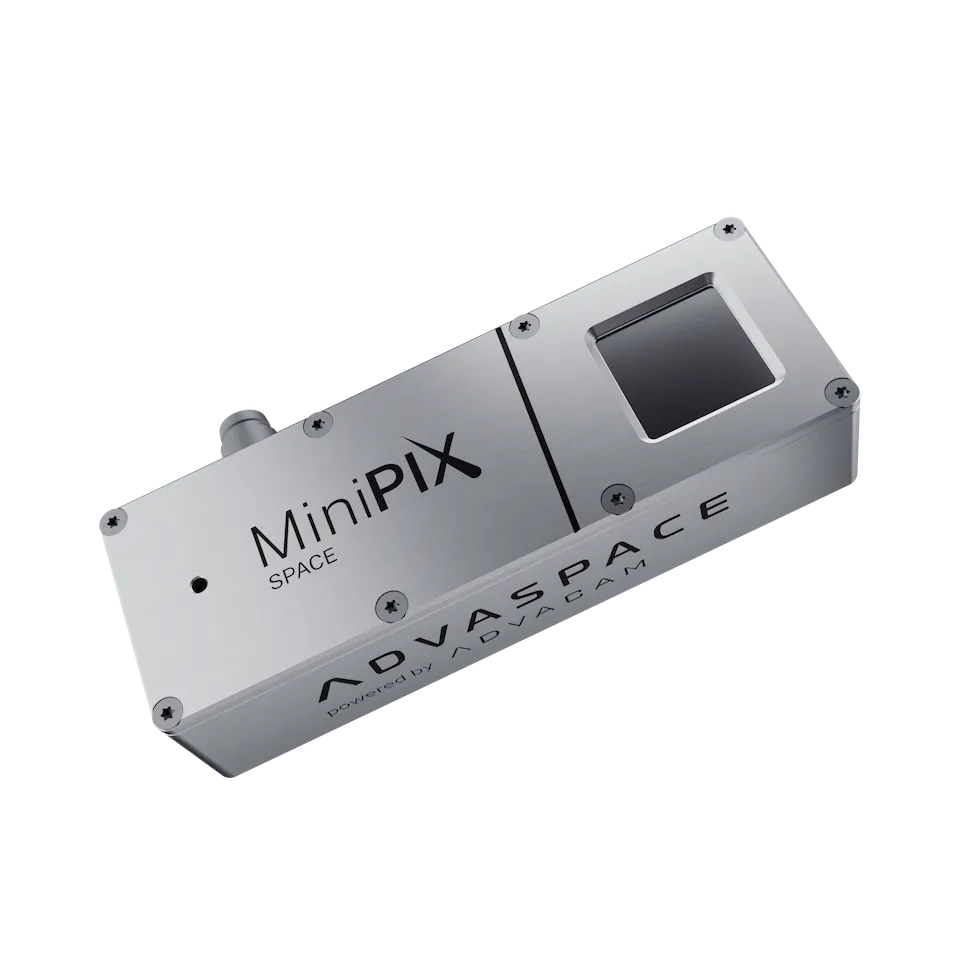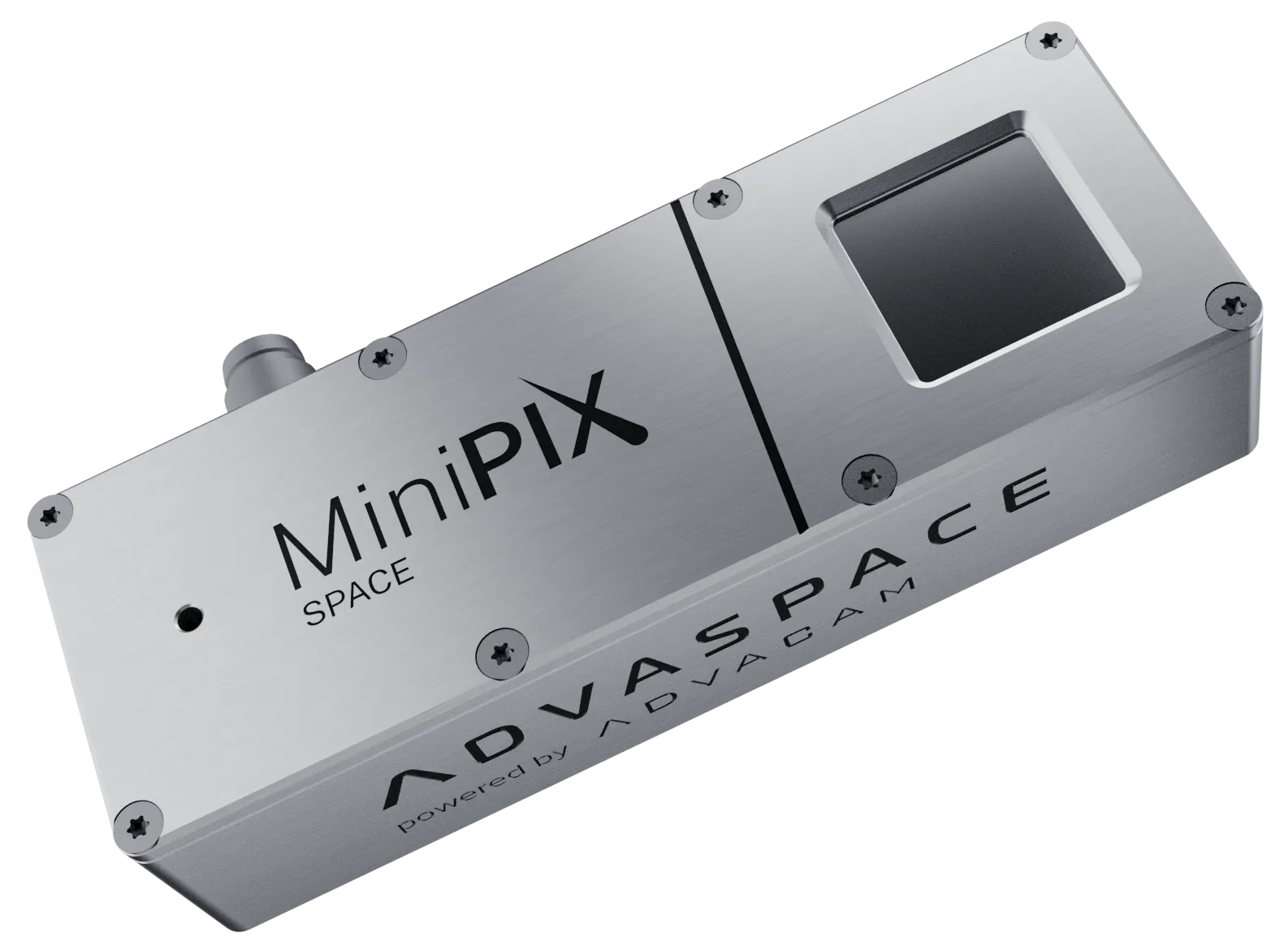
MiniPIX SPACE Detector
Miniaturized payload ready to perform particle-by-particle measurements

Detail information
The MiniPIX SPACE is a miniaturized and low-power radiation detector equipped with a photon-counting chip from the Timepix family for particle tracking. The Relevant radiation environment quantities such as Linear Energy Transfer (LET) and Total ionizing dose (TID) can be derived from the particle‘s track shape, flux and direction of flight.
The MiniPIXSPACE detector can be placed within the satellite payload or space station to monitor radiation (precise dosimetry) for your mission. Engineered for durability, it offers enhanced mechanical properties. It has passed stringent environmental testing, including a humidity test, a tri-axial vibration test, and a thermal ambience test, all conducted under ECSS standards.
MiniPIX SPACE is based on ADVACAM’s Timepix particle-tracking technology, which detects every individual ionizing particle hitting the sensor.
For each particle, the camera records:
- Particle type ( it can distinguish alpha, beta, gamma, proton, heavy ion, muon or neutron)
- Energy
- Direction of arrival
- Exact time of impact
- Track shape inside the detector
Using our TraX Engine post-processing services, operators can calculate radiation dose, linear energy transfer (LET), charge state, and other parameters essential to understanding the actual risk of a radiation environment.
Yes, MiniPIX SPACE has been launched into space. In addition, the device's key component, the Timepix photon-counting chip, has been proven on numerous space missions. It has been used in various MiniPIX device variants and as a component of NASA’s HERA Hybrid Electronic Radiation Assessor system. The chip is utilized on board the ISS for radiation monitoring. This includes NASA’s Artemis missions aboard the Orion spacecraft, SpaceX Crew Dragon Polaris Dawn, and the Astrobotic Peregrine lunar lander.
MiniPIX SPACE was also chosen as one of the instruments to measure the Internal Dosimeter Array within the ESA IDA project on board the International Gateway lunar space station.
Unlike conventional radiation monitors that provide only averaged intensity values, MiniPIX SPACE offers particle-by-particle analysis.
Key differences include:
- Identification of each detected particle
- Measurement of energy, direction, and timing
- Track-based radiation characterization
- Much smaller size and lower mass
- lower power consumption
This level of detail is critical for advanced radiation modeling, spacecraft protection strategies, and operational decision-making.
AIn principle - Yes.
The detailed particle data enables real-time radiation awareness (nowcasting) and supports short-term forecasting of radiation evolution minutes ahead.
This gives satellite operators time to:
- Place spacecraft into safe mode
- Switch off sensitive subsystems
- Reconfigure payload operations
- Activate shielding strategies
ABy enabling earlier reactions to radiation events and long-term performance monitoring, MiniPIX SPACE helps operators:
- Avoid permanent damage to spacecraft systems, such as Single Event Effects (SEEs) or solar-panel inefficiency
- Prevent premature mission termination
- Extend satellite operational lifetime
- Optimize constellation management
- Make informed deorbit decisions before the spacecraft is not operational
- Potentially reduce dependence on costly radiation-hardened components by replacing conservative design margins with real operational data
These capabilities can translate into substantial financial savings over the full mission lifecycle.
Absolutely.
The camera’s miniaturized dimensions, low mass, and minimal power consumption make it ideal for large constellations where payload volume and power budgets are critical.
Its compact design allows deployment across fleets to support fleet-level radiation monitoring and analytics.
Yes.
MiniPIX SPACE is:
- Vacuum-compatible below 10⁻³ Pa
- Temperature-stabilized via passive or optional active cooling
- Qualified through ECSS-compliant environmental testing
- Proven during missions on the ISS and on satellites in orbit
These credentials demonstrate long-term reliability in harsh orbital environments.
MiniPIX SPACE is powered by Timepix technology originally developed within the CERN ecosystem and protected by international patents held by CERN, academic institutes, and ADVACAM.
The system is supported by a large body of peer-reviewed scientific publications in the field of space radiation.
Yes.
Along with the MiniPIX SPACE hardware, AdvaSpace provides its in-house radiation data processing and visualization platform TraX Engine, designed to turn raw detector output into actionable operational intelligence for satellite operators and mission teams. The system is provided as a managed data-processing service. AdvaSpace manages the entire analysis workflow and delivers ready-to-use results.
- Total and partial radiation dose and dose rate
- Particle flux and directional flux
- Deposited energy spectra
- Linear energy transfer (LET) distributions
These parameters are essential for understanding radiation hazards to spacecraft electronics and materials.
AdvaSpace supplies MiniPIX SPACE as a plug-and-play satellite radiation subsystem, including:
- Mechanical and electrical interfaces
- Integration documentation. The device is delivered with a complete instrument data pack, including ICD, DML, DMPL, and more.
- Mission support
- Optional downstream radiation data services
This reduces spacecraft development time and lowers mission risk.
Yes.
Although designed for orbital missions, MiniPIX SPACE is also well suited for high-altitude aviation, critical infrastructure monitoring, and scientific research outside space. Offered by AdvaSpace, it can be deployed as part of airborne systems, ground installations, or hybrid monitoring services.
Typical non-space applications include:
Aviation and Aerospace Manufacturing
- Monitoring radiation exposure at cruising altitudes
- Supporting crew safety and regulatory compliance
- Assessing avionics vulnerability during solar storms
- Optimizing flight routes during elevated radiation events
- Distinguishing harmful radiation from benign background components
Power Grids and Critical Infrastructure
- Supporting space-weather early-warning systems
- Correlating geomagnetic storms with grid disturbances
- Verifying radiation effects directly at infrastructure sites
- Improving insurance claims and risk assessment
- Guiding protection strategies for transformers and networks
Scientific and Technology Missions
- Providing radiation context for biological and material experiments
- Correlating test results with radiation exposure
- Supporting technology validation campaigns
- Enabling advanced radiation environment modeling
Thanks to its compact size, low power consumption, and particle-resolved measurements, MiniPIX SPACE extends beyond satellites to become a versatile radiation-monitoring tool for air, ground, and research applications alike.
3D model
Connectivity:
UART or SPI for communication with a robust interface connector according to customer preference. Usually M8 or Micro-d).
Compact and Low-powered:
up to 90 x 32 x 11 mm
up to 140g
less than 3 W
Timepix photon-counting chip:
particle type, energy, direction of arrival, exact time of impact, and track shape for every particle
Space Heritage:
Timepix-based detectors are proven in dosens space missions
Why AdvaSpace?
Detect and distinguish every single particle
Integrate it into your mission. It’s easy.
Protect your assets with data. Reduce radiation-driven failures
Product video
Technical specification
Space Weather Nowcasting & Forecasting
FAQ
The device can directly detect all types of ionizing radiation, including alpha, beta, gamma, protons, heavy ions, and muons.The device can indirectly detect the following radiation typesNeutrons, if a convertor is used (thermal and fast, based on the convertor material used)
The numbers bellow characterizes full capability of the sensor; such data likely couldn´t be used for fulfilling the scientific objective. A separate discussion is recommended to discuss the performance of the device for a particular scientific objective.The device can measure up to 10^8 hits/s in frame modeThe device can measure energy up to 2 MeV/pixel/frame
Particles are detectable above the device’s threshold, which is typically set to 3 keV.For high-energy particles (e.g., heavy ions and protons), only the energy deposited in the detector is recorded.The detector can register particles once they exceed the internal detection threshold, typically around 3 keV. In principle, there is no strict upper limit. However, the particle must deposit energy in the silicon sensor to be measured. High-energy charged particles such as protons, helium ions, and heavy ions are therefore always detected, but only the energy deposited in the sensor is recorded, not the particle’s full incident energy. Even particles in the GeV range can be detected, provided they interact within the sensor material.
Detection threshold: 3 keV
Energy measurement error 5-10 %
Time resolution 1,56 ns
Pixel size (spatial resolution): 55 x 55 μm
The detector is sensitive to photons and charged particles with energies above approximately 3 keV. The typical energy resolution at 60 keV is 1.2-3 keV, depending on the configuration. For higher-energy charged particles, the measurement uncertainty of the deposited energy strongly depends on the type of particle and its energy. Could you specify what particle and with what energy you expect?
The measured data can be post-processed using a particle identification script.Please see the "commissioning and data processing", "scientific data outputs" documents for further information.
The device is a single particle counting detector; it can measure even single-pixel hit events.A separate discussion is recommended to provide inputs for the scientific objective of the mission.
The device operates as a single-particle counting detector, capable of registering even single-pixel hit events. It can detect individual particles whenever they interact with the sensor, offering essentially 100% detection efficiency for charged particles. For photons, detection is probabilistic and depends on the photon energy and interaction probability. See plot below:
The device operates based on ionization caused by incoming particles. The generated charge is collected on a capacitor, which is then discharged using a known discharge function.The discharge time is measured, and—based on calibration—the time is converted into the energy deposited in the detector. A 40 MHz internal clock is used for ToT (Time over Threshold) measurement.For high-energy particles such as heavy ions, the same principle is used, but only the deposited energy in the sensor is measured.To determine the particle direction, the device utilizes the sensor’s thickness. Although the sensor is only 500 µm thick, a traversing particle leaves a visible track, which is post-processed to derive the particle’s direction.
The TPX3 chip (sensitive area) is a radiation-hardened component. The readout electronics use COTS components, but the readout electronic is shielded.The total ionizing dose tolerance of the MiniPIX device has not been measured.The device has a proven track record in LEO (Low Earth Orbit) conditions — see the heritage sheet for reference missions.
The device has a proven track record in terrestrial environments with high radiation levelsThe MiniPIX system does not have a formally specified Total Ionizing Dose limit. However, based on its flight heritage in Low Earth Orbit, it has operated reliably under typical LEO radiation levels with no degradation observed.
The device does not contain any SEU detection or mitigation features.The device has a proven track record in space and in terrestrial heavy radiationThe device does not implement specific Single Event Upset detection or mitigation mechanisms. Nevertheless, it has demonstrated reliable performance in previous space missions as well as in demanding terrestrial radiation conditions.
Currently, there are detectors lasting more than 5 years in orbitThe actual expected lifetime could vary based on the particular missionPlease see heritage sheet for more informationThe detector's degradation process is difficult to predict because it depends on numerous mission-specific factors. Consequently, even extensive prior experience cannot reliably forecast the detector behavior during a particular mission. Currently, there are detectors lasting more than 5 years in orbit without any measurement issues.
The device uses known X-ray and gamma sources for calibrationA separate discussion can be held to provide more information regarding calibration
Before calibration, basic sensor functions are verified, including checking the digital operation of all pixels and performing bias leakage tests. Sensor uniformity is then calibrated using threshold equalization. Energy calibration is carried out with a series of reference sources: Iron (6.4 keV - XRF), Cadmium (23.2 keV - XRF), and Americium (59.5 keV). The Time-over-Threshold (ToT) response is linear up to 150 keV, with a correction applied for higher energies to maintain accuracy. For detailed information, see the "Calibration protocol" attached.
The device should be thermally stabilized. Small temperature fluctuations (±5°C) from the calibration temperature have a low influence on the measured data.The device contains two calibrations for different temperatures to allow for a wider temperature interval of measurementsThe device can be custom-calibrated to a predicted spacecraft temperature to achieve the best results.The device should be operated at 0-10^-3 Pa and 50-100 kPa ranges.
The pixel mode is not recommended for space applications; a more in-depth discussion can be held in person on this topic.
The maximum theoretical hit pixels per frame is 6.7*10^7A separate discussion concerning a scientific objective of the mission is recommendedIn a case wehen customer intends to use particle identification algorythms it is necessary to limit the frame occupancy to about 10 %. (cca 6500 hits frame in ToA + ToT mode (Time of arrival + time over Treshold)
The device should be placed on a thermally stabilized surface, preferably one that can act as a heat sink.
The device shouldn't be affected by a propulsion plume ,and shouldn't be shielded by other structures such as solar panels and antennaeThe device should be mounted on a thermally stabilized surface, preferably one that can serve as a heat sink (like a block of material, like aluminum) to help maintain stable operating temperatures and protect the device from ever overheating. Additionally, it should be positioned to avoid exposure to propulsion plumes and not be shielded by other satellite structures, such as solar panels or antennas, to ensure clear particle detection.
The amount of data generated depends on the measurement parameters and the radiation measuredEach hit generates 6 bytes of information in Toa + ToT (Time of Arrival + Time over Threshold)A dedicated data budget discussion can be heldThe device can operate in two measurement modes: active adjustment of frame acquisition time or fixed sequential frame acquisition. In the active adjustment mode, the frame acquisition time varies based on particle flux. Under low flux conditions, this mode generates approximately 60 MB of data per day, while during high-intensity events (e.g., solar storms), data output can increase up to 1 GB per day. The fixed sequential frame acquisition mode produces roughly three times more data under similar conditions.Files included: Scientific Data Outputs, Commissioning and Data Processing, Calibration protocol
The device uses an M8 connector